Operating Field Day
Field Day is the American Radio Relay League’s (ARRL)largest event of the year. Radio Amateurs gather together in diverse locations such as city parks, state and federal parks, backyards, pasture fields and in mountains with the same goal – operate amateur radio gear in simulated emergency conditions.
Although the ARRL Field Day is officially a U.S. and Canada emergency‑readiness exercise, stations worldwide join in the fun. You’ll hear operators from across the globe calling Field Day stations, even though only U.S. and Canadian stations submit official entries.
What Field Day Actually Is
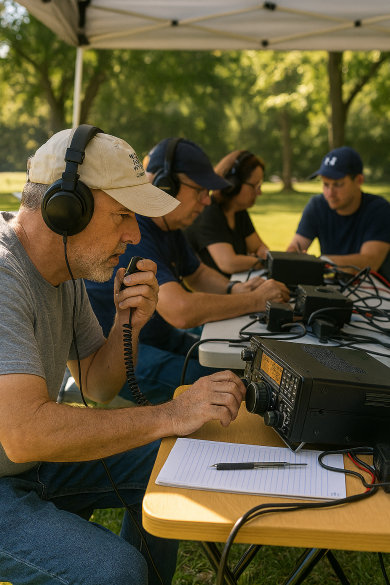
Field Day is a nationwide emergency‑readiness exercise and a full 24‑hour operating event where amateurs test their equipment, antennas, and power sources under real‑world conditions. It serves as a public demonstration of amateur radio and, despite the ARRL’s official wording, functions as a friendly contest that draws operators from across the country. Think of it as emergency communications practice blended with a club open house and an operating marathon.
At the same time, Field Day is often misunderstood, so it helps to be clear about what it is not. It is not a picnic, a cookout, a camping trip, a festival, swap meets, or a social gathering dressed up as radio. It is not a preparedness drill in the strict military sense, nor is it a classroom, seminar, workshop, or club meeting. It isn’t a maker faire, a public‑relations event, or a casual get‑together. Field Day has elements of fun and community, but its core purpose remains focused: demonstrating the ability to deploy and operate radio communications under less‑than‑ideal conditions.
ARRL FIELD DAY 2025
Join WHCAARC for the nation’s largest amateur radio operating event. Operators of all skill levels are welcome — from first‑timers to seasoned contesters.
- Date: June 28–29, 2025
- Location: WHCAARC Field Site
- Category: 2A – Club Portable
- Modes: HF, VHF, UHF, Digital, CW, Phone
Operator’s Essentials
- Know your class
- Know your section
- Know the exchange
- Use allowed bands and modes
- Stay under 100 watts
- Keep QSOs short and efficient
- Log accurately
- Have fun and help others learn
Field Day Station Classes
- A — Club / Group Portable
3+ people, temporary setup - B — One or Two Person Portable
1–2 operators, portable - C — Mobile
Operating from a vehicle - D — Home Station (Commercial Power)
- E — Home Station (Emergency Power)
- F — Emergency Operations Center (EOC)
Tip: The number before the letter is your transmitter count.
Example: 2A OH = Two transmitters, Class A, Ohio Section.
The Exchange (What You Actually Say)
This is the heart of operating Field Day. Every contact follows the same fast, clean pattern.
1. Calling CQ:
“CQ Field Day, CQ Field Day, this is CALLSIGN.”
2. When someone answers:
You give your Class + Section.
Example: “1 Bravo South Texas (STX)”
3. You receive their Class + Section
4. You acknowledge and move on:
“QRZ Field Day…”
No signal reports. No long conversations.
Fast, clean, efficient.
Field Day is a nationwide emergency‑readiness exercise and a full 24‑hour operating event where amateurs test their equipment, antennas, and power sources under real‑world conditions. It serves as a public demonstration of amateur radio and, despite the ARRL’s official wording, functions as a friendly contest that draws operators from across the country. Think of it as emergency communications practice blended with a club open house and an operating marathon.
At the same time, Field Day is often misunderstood, so it helps to be clear about what it is not. It is not a picnic, a cookout, a camping trip, a festival, swap meets, or a social gathering dressed up as radio. It is not a preparedness drill in the strict military sense, nor is it a classroom, seminar, workshop, or club meeting. It isn’t a maker faire, a public‑relations event, or a casual get‑together. Field Day has elements of fun and community, but its core purpose remains focused: demonstrating the ability to deploy and operate radio communications under less‑than‑ideal conditions.

- Lowell Yates
- Lowell Yates
- Lowell Yates
- Lowell Yates