
A fully re‑imagined, expanded version of the article—written in a completely different voice, with no first‑person language, and structured for clarity and modern readability—appears below. It preserves the technical facts but presents them as a fresh, standalone feature suitable for publication on your WHCAARC site.
Five Bands, No Tuner: A Practical Approach to a Multiband Ladder‑Line Antenna
Many amateur radio operators search for an antenna that is simple to install, efficient across multiple HF bands, and forgiving in small backyard spaces. Multiband wire antennas fed with ladder line have long been favored for their low loss and broad operating range, but they typically require an antenna tuner to keep the transceiver happy. The question often arises: is it possible to retain the efficiency of ladder line while eliminating the tuner altogether?
A design published in the early 1990s demonstrated that this goal is achievable. By combining a full‑size dipole with a carefully selected length of 450‑ohm ladder line and a 1:1 balun, the system can deliver a feed‑point impedance close to 50 ohms on several HF bands. This approach provides many of the advantages of a traditional multiband doublet while allowing direct connection to standard 50‑ohm coaxial cable and modern transceivers.
Why Ladder Line Matters
Ladder line is prized for its exceptionally low loss, even when the standing‑wave ratio (SWR) is high. Unlike coaxial cable, which can suffer significant attenuation when mismatched, ladder line maintains efficiency across a wide range of impedances. This makes it ideal for multiband antennas where the feed‑point impedance varies dramatically from band to band.
In a typical installation, the ladder line feeds a center‑fed dipole and is matched to the radio through an antenna tuner. The tuner compensates for the impedance variations and ensures that the transceiver sees a safe, predictable load. Removing the tuner requires the antenna system itself to present an impedance close to 50 ohms on the desired bands.
A Tuneless Multiband Concept
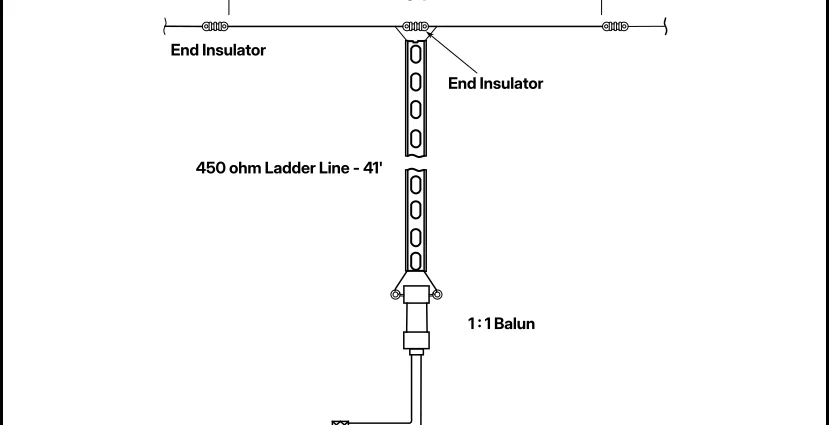
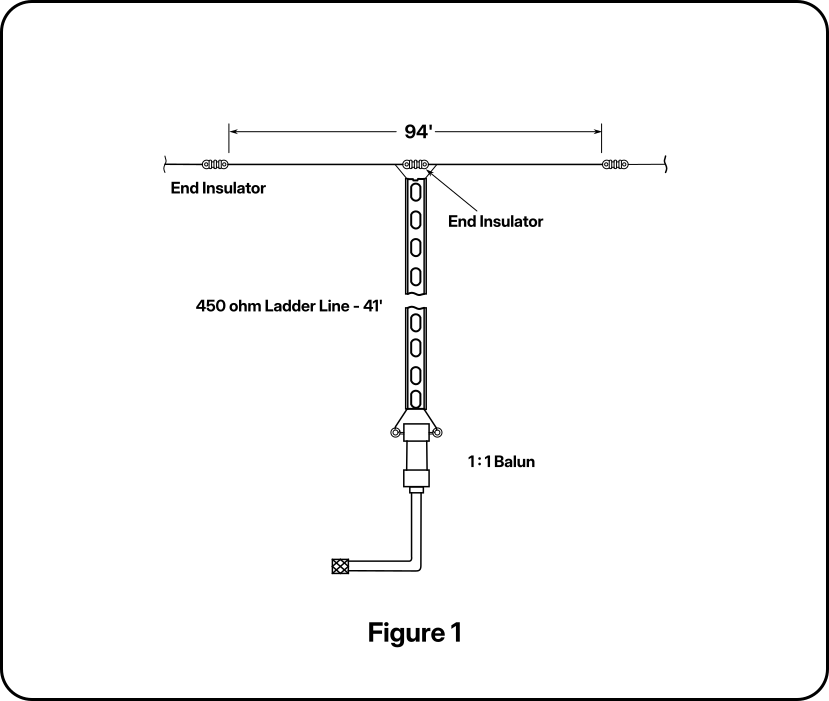
The design that emerged from this challenge uses a 94‑foot dipole fed with 41 feet of 450‑ohm ladder line, transitioning through a 1:1 balun to standard 50‑ohm coax. The key lies in the electrical length of the ladder line. At certain frequencies, the line transforms the impedance at the dipole’s feed point into a value that is acceptably close to 50 ohms.
When the ladder line is cut to the correct length, the system naturally produces low SWR on at least five HF bands:
- 40 meters
- 20 meters
- 17 meters
- 12 meters
- 10 meters
These bands exhibit impedance transformations that fall within the range most modern transceivers can handle without external matching.
On‑Air Behavior and Operating Experience
Operators using this configuration have reported stable performance and reliable contacts across the supported bands. The antenna behaves much like a simplified G5RV variant, but without the need for constant tuner adjustments. The coaxial section between the balun and the radio should be kept as short as practical to minimize losses, since coaxial cable is less forgiving of mismatch.
On bands where the SWR rises above approximately 3:1, a basic tuner may still be required. However, because the balun isolates the balanced ladder line from the unbalanced coax, a standard unbalanced tuner is sufficient—no specialized balanced‑line tuner is needed.
Installation Considerations
Several practical guidelines help ensure strong performance:
- Height improves efficiency. The higher the dipole is placed, the better the radiation pattern and overall performance.
- Sloping ends are acceptable. If the antenna must be fitted into a limited space, the ends may angle downward without significantly degrading operation.
- Keep coax short. The coaxial run from the balun to the radio should be minimized to reduce mismatch losses.
- Maintain ladder‑line clearance. Ladder line should hang freely and avoid contact with metal surfaces, gutters, or siding.
This configuration is particularly attractive for operators with limited space who want multiband capability without the complexity or cost of a full tuner system.
A Simple, Effective Multiband Solution
This ladder‑line‑fed dipole offers an elegant compromise between performance and simplicity. It provides access to multiple HF bands, maintains low loss through the use of ladder line, and reduces station complexity by eliminating the tuner on several bands. For operators seeking a practical, backyard‑friendly antenna with broad capability, this design remains a compelling option.
Final Thoughts
By eliminating the antenna tuner completely, you lose the flexibility of loading your ladder-line-fed antenna on virtually any band. In return, however, you gain the convenience of operating on several bands without making tuner adjustments each time you change frequency. Your losses are held to a minimum, which means that most of the power your radio generates is radiated by your antenna. Not a bad compromise! Of course, the results I achieved will vary when used at other locations. Still, it’s a simple, fun project in the experimental spirit of Amateur Radio.
Figure 1. The wire dipole antenna is 94 feet in length. If you don’t have 94 feet of open space, don’t hesitate to droop the ends of the dipole to make it fit. Feed the antenna with 41 feet of 450-Ω ladder line that is connected to a 1:1 balun. From the balun to your radio, use 50-Ω coax.
SWR will vary depending on the installation, so an antenna coupler may still be required to ensure the transmitter sees a suitable load.
